

The right optical turnstiles for corporate lobbies clear peak arrival without a queue, catch a tailgater without stopping the person in front, and look like they belong in the building. Fastlane® speed gates for corporate lobbies from Smarter Security cover that brief across a range of models. This list walks through seven examples, each matched to the lobby it fits. The full lineup is on the Fastlane turnstiles and speed gates page.
What You’ll Learn in This Article
- Seven examples of how Fastlane models map to a Class A lobby, a footprint match, a wide lane, a tall-barrier site, or a data center
- The lane width, barrier height, and footprint numbers that separate one model from the next
- How to size lane count from your peak 15-minute arrival window
- Where Sidegate Detection® matters and where it does not
- What every Fastlane optical turnstile has in common, so you can compare on the differences
Optical Turnstiles for Corporate Lobbies: The Quick Pick
Discover seven captivating lobby scenarios, each thoughtfully matched with an ideal Fastlane model to enhance efficiency and guest experience. These scenarios not only illustrate practical applications but also highlight the versatile nature of the Fastlane models. Additionally, a range of exciting alternative models is available, tailored to meet a diverse array of unique cases, ensuring that every situation can be addressed with precision and effectiveness. Whether you’re seeking solutions for high-traffic environments or specialized needs, there’s a model designed just for you!
| Your lobby | Fastlane model | The number that matters |
|---|---|---|
| Class A office, new build | Glassgate 150 Plus | 39.4″ (1000 mm) lane option, concealed sensors |
| Replacing an existing older Glassgate 150 installation | Glassgate 150 LX | Bolt-for-bolt with the original footprint |
| Deliveries, carts, mobility devices | Glassgate 155 | 47.24″ (1200 mm) lane with Sidegate Detection® |
| Taller glass without a heavy look | Glassgate 250 Plus | Glass barriers to 66.9″ (1700 mm) |
| Higher security, minimal pedestal | Glassgate 300 | 9.4″ (240 mm) pedestal, glass to 70.9″ (1800 mm) |
| Open, welcoming lobby | Glasswing | Wing barriers retract flush into the pedestal; three pedestal widths |
| Data center, one person per authorization | Fastlane Interlock | Two barrier sets, only one opens at a time |
What Every Model on This List Shares
Compare these seven, and any other Fastlane model, on their differences, because the fundamentals are the same across the line:
- 60 people per minute per lane
- ¼” (5 mm) tailgate detection
- Neural-network processing that tells a person from a bag, a cart, or a wheelchair, which is what keeps false alarms down
- Rated for 10,000,000 cycles
- ADA-compliant lane configurations
- Fastlane Connect IP for browser-based control and diagnostics
That shared baseline is what makes the choice manageable for a specifier. Detection accuracy, throughput, and cycle life do not change from one Fastlane model to the next, so the specification can lock those numbers in once and leave the model decision to the questions that do vary: lane width, barrier height, pedestal footprint, and whether the entrance needs verified single-person passage. The seven entries below are organized around exactly those questions.
1. Fastlane Glassgate 150 Plus: The Class A Default
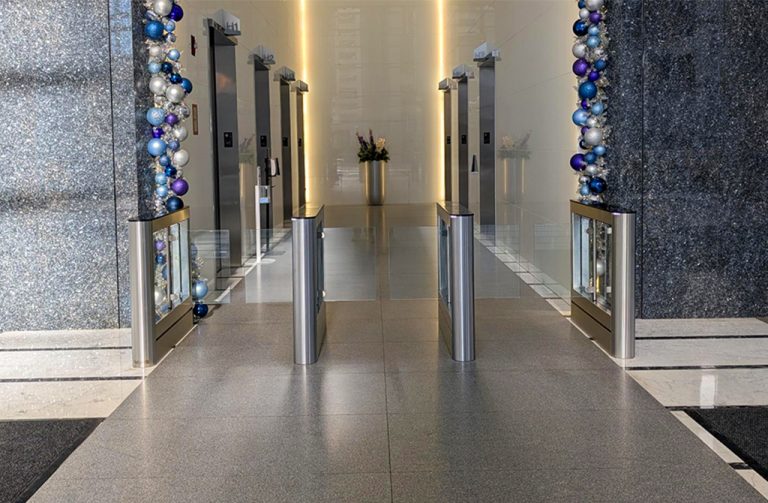
Best for: corporate headquarters, multi-tenant high-rises, professional services lobbies.
Since its launch, the Glassgate 150 Plus has become the most frequently specified mid-height speed gate for corporate lobbies. The beam matrix is windowless, so the pedestal reads as a clean surface rather than a row of sensor ports. It comes in standard width or a 39.4″ (1000 mm) lane, which covers ADA without a separate access gate in most layouts.
Watch for: if the lobby moves gurneys, pallets, or bicycles, step up to the Glassgate 155.
2. Fastlane Glassgate 150 LX: The Footprint Match
Best for: replacing an original Glassgate 150 without floor work, or any lobby that wants the original 150 footprint.
The 150 LX bolts onto the existing Glassgate 150 footprint. Same anchor points, same floor cut, no demolition. You get current detection electronics and Fastlane Connect IP without reopening the lobby floor. For a four-lane lobby that is the difference between a weekend swap and a construction project. It is a full current-generation turnstile, not a retrofit kit, so it also stands on its own in a new build.
Watch for: if there is no existing Glassgate 150 footprint to match, compare the LX against the 150 Plus on beam matrix and lane width rather than on retrofit fit.
3. Fastlane Glassgate 155: The Wide Lane Optical Turnstile
Best for: corporate campuses with loading traffic through the lobby, healthcare, research buildings, anywhere a wheelchair and a delivery cart use the same entrance.
Lane widths run to 47.24″ (1200 mm), and the pedestal hides the optics behind waist-height glass. A wide lane invites two people to walk through side by side, so the 155 carries Sidegate Detection®, which reads two bodies crossing together as an event rather than one large person. That is the feature that makes a wide lane secure instead of just wide.
Watch for: a 47″ lane needs the floor space. Confirm the footprint against your lobby drawing before you commit.
4. Fastlane Glassgate 250 Plus: Taller Glass, Full-Width Pedestal
Best for: lobbies that want a visible deterrent without moving to a high-security product.
The 250 Plus builds on the Glassgate 250 with tall glass barrier options up to 66.9″ (1700 mm). Bi-directional dual glass barriers close from both sides of the lane, and the metal side panels leave room inside the pedestal for reader and display integrations.
Watch for: if the requirement is glass near 6 feet with the slimmest possible pedestal, the Glassgate 300 is the better fit.
5. Fastlane Glassgate 300: High Security, Nine-Inch Pedestal
Best for: financial services, pharmaceutical, government contractors, and any lobby where the barrier height is written into the spec.
The Glassgate 300 is a T-shaped pedestal 9.4″ (240 mm) wide with glass sides, so the lane stays visually open even with barriers at 59.1″ (1500 mm), 66.9″ (1700 mm), or 70.9″ (1800 mm). Nearly six feet of glass takes climb-over off the table. A locking brake option holds the barriers closed under force.
Watch for: taller glass means a taller swing arc. Check clearance to adjacent walls and desks.
6. Fastlane Glasswing: The Retracting Barrier
Best for: lobbies where the entrance should feel open and welcoming, with barriers that swing out of sight the moment someone is authorized.
The Glasswing’s wing-shaped glass barriers retract flush into the pedestal, so the lane is fully clear once someone is authorized. It comes in three pedestal widths, 12.1″ (307 mm), 14.6″ (371 mm), and 17.8″ (452 mm), with elliptical or square ends, and lane widths of 21.7″ (551 mm), 26.0″ (660 mm), or 36.0″ (914 mm) ADA. Detection runs on a 32-beam infrared matrix with ¼” (5 mm) tailgate detection.
Watch for: barrier height is 36.5″ (927 mm) across the range. If the specification calls for taller glass, the Glassgate 250 Plus or Glassgate 300 is the fit.
7. Fastlane Interlock: One Person, Verified
Best for: data centers, critical infrastructure, defense contractors, and secure floors inside an otherwise ordinary corporate building.
The Interlock uses two sets of barriers that operate independently but are interlocked so only one set opens at a time. A person enters, the first set closes, the system verifies single occupancy, and the second set opens. It accepts one or several authentication methods in sequence. Throughput may be lower than a speed gate by design.
Watch for: two barrier sets need a longer lane and a clear path on both sides. Confirm the footprint fits the corridor or vestibule before it goes on the drawing.
How Many Lanes Does a Corporate Lobby Need?
Take your busiest 15-minute window. Divide arrivals by 15 to get people per minute. Divide that by 60 (the per-lane rating for every model above) and round up. Specify every lane in the same model. If you need a wider entry point for deliveries or accessibility beyond what your chosen model’s lane width covers, add a Fastlane access gate (Intelligate 300 or Passgate 300) next to the lanes.
Example: 450 people arrive between 8:45 and 9:00. That is 30 per minute, so one lane is enough on paper. Specify two so a single alarm does not stall the entrance, plus an access gate if deliveries come through the lobby.
The enterprise specification guide covers integration protocols, credential types, and safety requirements in depth. For the wider question of optical turnstiles versus other turnstile types, see best turnstiles for office buildings. If none of the seven scenarios above matches your lobby, the full Fastlane lineup includes models built for other cases.
Frequently Asked Questions
Which Optical Turnstiles Are Best for High-Throughput Lobby Security?
Speed gates rated at 60 people per minute per lane, with detection that ignores bags and carts so the lane does not stop on false alarms. Every Fastlane optical turnstile on this list meets that rating. The Glassgate 150 Plus is the usual choice for a high-volume corporate lobby.
Which Optical Turnstiles Are Best for Large Corporate Lobbies?
Large lobbies run several lanes of a single Fastlane model, so every lane detects and moves people the same way. The Glassgate 150 Plus is a common choice for a high-volume corporate lobby. When one entry point needs to be wider for carts, deliveries, or accessibility, add a Fastlane access gate such as the Intelligate 300 or Passgate 300 alongside the turnstile lanes rather than mixing turnstile models.
What Is the Difference Between a Glassgate 150 Plus and a Glassgate 150 LX?
Both are mid-height speed gates that work for new installations and for replacing existing turnstiles. The 150 Plus has a windowless beam matrix and a 39.4″ lane option. The 150 LX matches the footprint of the original Glassgate 150, so it bolts onto existing anchor points with no floor work, which makes it the faster path when a Glassgate 150 is already in place.
Do Wide-Lane Optical Turnstiles Reduce Security?
Not when the lane has side-by-side detection. Sidegate Detection® on the Glassgate 155 identifies two people crossing together through one lane. Without it, a wide lane is easier to tailgate through.
When Does a Corporate Building Need a Fastlane Interlock Instead of a Speed Gate?
When the requirement is verified single-person passage, such as the entrance to a data hall or a secure floor. Speed gates detect and alarm on tailgating. The Interlock physically prevents it by holding the second barrier set closed until the lane is confirmed to hold one person.



