
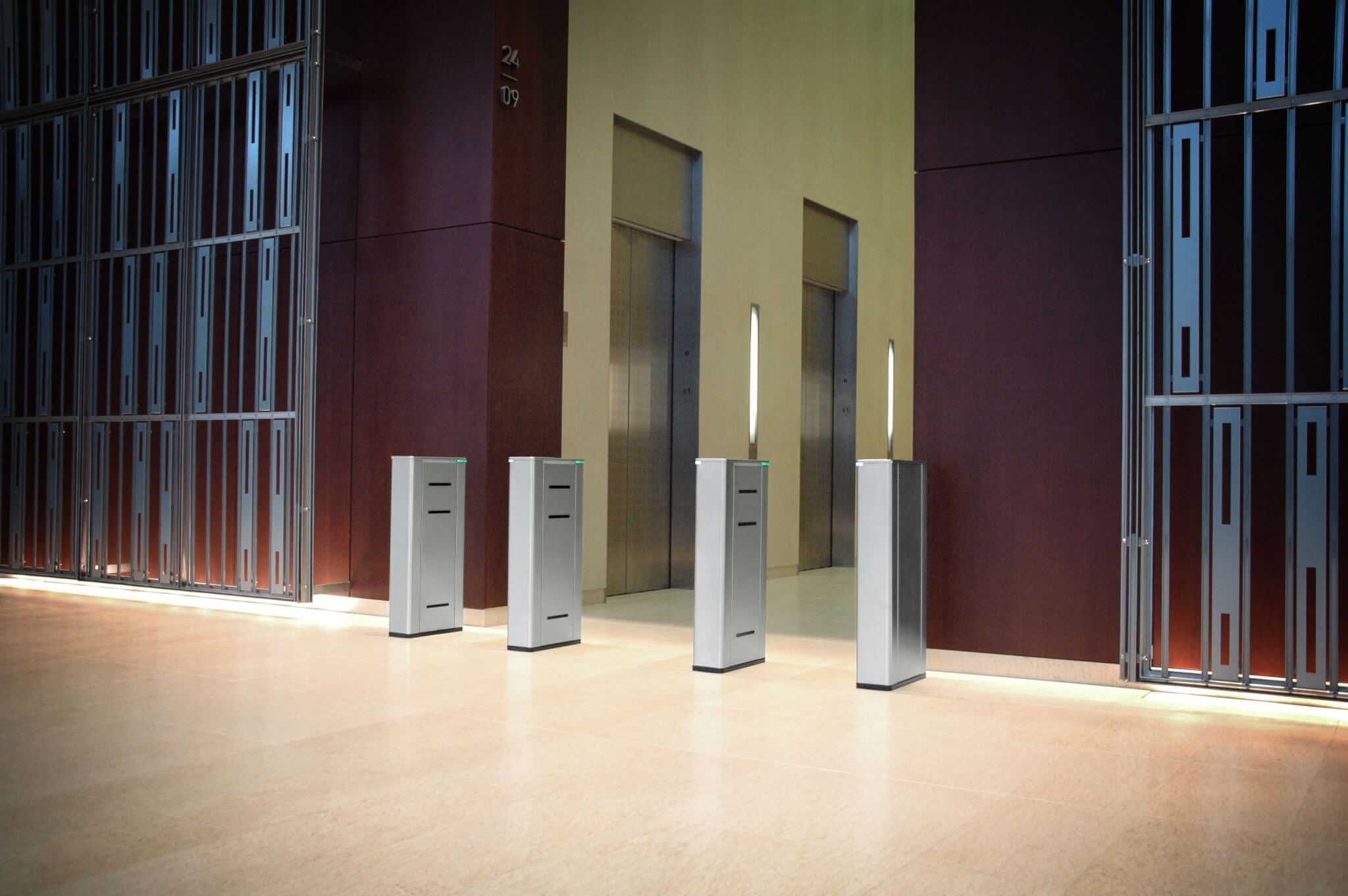
When you compare speed gates vs. optical turnstiles, you’re really comparing a category to one of its members. A speed gate is an optical turnstile fitted with moving glass barriers. “Optical turnstile” covers any lane that uses infrared beams to detect passage. “Speed gate” is the barrier-equipped version built for throughput. Which one fits comes down to barrier type, security level, and how busy the entrance gets.
What is an optical turnstile?
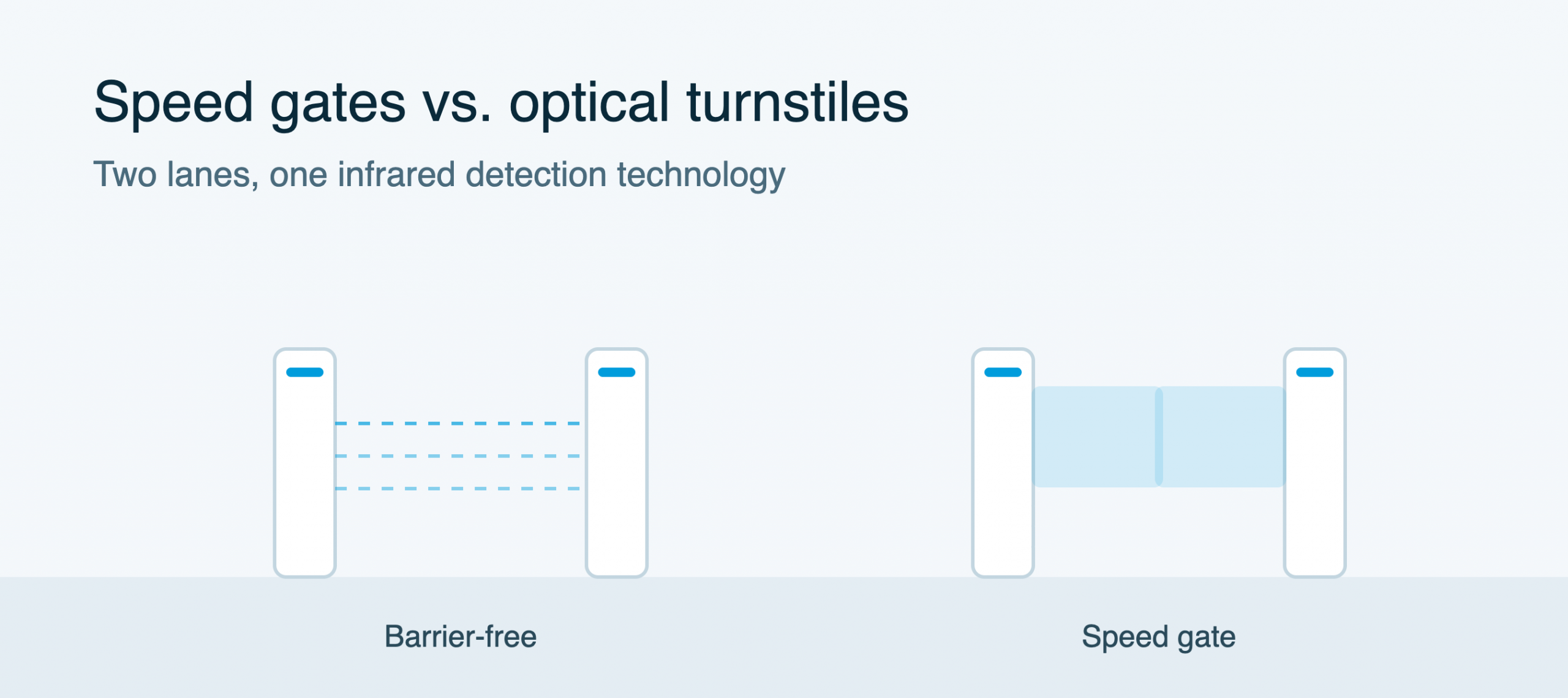
An optical turnstile is a pedestrian entrance-control lane. It uses an infrared beam matrix to detect people passing through, and it separates authorized entries from tailgating and piggybacking attempts.

Optical turnstiles come in two broad forms:
- Barrier-free: no physical barrier; the sensors detect unauthorized passage and trigger an alarm, but nothing physically blocks entry. Barrier-free turnstile options from Smarter Security include the Fastlane Compact and Fastlane 400 OT
- Barrier (speed gate): a glass barrier that remains closed until an authorized credential is presented, then opens and recloses behind the user.
 What is a speed gate?
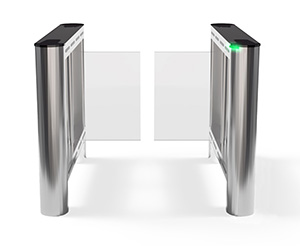
A speed gate is an optical turnstile with moving glass barriers built for throughput. The barriers open on authorization and close behind each user, which adds a visible physical deterrent on top of sensor-based detection. Fastlane® Glassgate models are speed gates. They use bidirectional swinging glass barriers and a high-resolution infrared matrix that detects tailgaters as close as 1/4″ (5mm) apart.
“Speed gate” is a common industry and marketing label, not a separate technology. Every speed gate is an optical turnstile. Not every optical turnstile is a speed gate.
Speed gates vs. optical turnstiles: side-by-side
| Barrier-free optical turnstile | Speed gate (barrier optical turnstile) | |
| Physical barrier | None | Glass barriers that open and close |
| Primary deterrent | Alarm on unauthorized entry | Physical barrier + alarm |
| Security level | Detection | Detection + physical deterrence |
| Throughput | Very high (no barrier cycle) | High (up to ~1 person/second) |
| Best for | High-trust interior checkpoints | Main lobbies, mixed-traffic entrances |
| Aesthetics | Minimal footprint | Glass barriers, architectural finish options |
How do I choose between them?
The decision usually comes down to three questions:
- How much do you need to physically stop, versus detect? Barrier-free lanes detect and alarm; speed gates add a physical barrier that closes on unauthorized attempts. Higher-security lobbies typically specify barriers.
- What’s the traffic pattern? Both handle high volume. Barrier-free lanes edge ahead on raw throughput; speed gates balance throughput with deterrence.
- What does the space demand aesthetically? Speed gates offer glass barriers and finish options that suit a designed lobby; barrier-free lanes offer the smallest footprint.
Where Door Detective fits
Neither type can be installed at a swing door. Door Detective® secures access-controlled doorways while they are open. It enforces direction integrity and catches tailgaters where a turnstile cannot be fitted. It complements optical turnstiles rather than replacing them, and it is not a turnstile itself.
FAQ
Q: Is a speed gate the same as an optical turnstile? A speed gate is a type of optical turnstile, one fitted with moving glass barriers. “Optical turnstile” is the broad category for any lane using infrared detection. “Speed gate” is the barrier-equipped version built for high throughput. Every speed gate is an optical turnstile, but not every optical turnstile is a speed gate.
Q: What is the difference between a barrier and barrier-free optical turnstile? A barrier optical turnstile, or speed gate, has glass barriers that stay closed until an authorized credential is presented, which adds a physical deterrent. A barrier-free optical turnstile has no physical barrier. Its sensors detect unauthorized passage and trigger an alarm, but nothing physically stops entry.
Q: Which is more secure, a speed gate or a barrier-free turnstile? Both detect tailgating with the same optical sensor technology. A speed gate adds a glass barrier that closes on an unauthorized attempt, so it has a physical deterrent a barrier-free lane does not. Higher-security lobbies typically specify barrier speed gates.
Q: Do speed gates slow down entry? No. Speed gates are built for high throughput. Fastlane® Glassgate models support up to one person per second, with barriers that open on authorization and reclose behind each user.
Still weighing barrier-free versus speed gate for your entrance? Our team can help you match the right Fastlane lane to your traffic, security level, and lobby design. Talk to a Smarter Security specialist.
This article was reviewed for accuracy by the Director of Marketing, Shana McCoy
Shana McCoy is the Director of Marketing at Smarter Security, the exclusive Americas distributor of Fastlane® optical turnstiles and Door Detective® entrance control solutions. With over a decade of experience in the physical security industry, Shana brings deep expertise in entrance control technology, serving clients across corporate, healthcare, education, and government sectors — including more than half of the Fortune 100. Her work spans product marketing, campaign strategy, and content development, with a focus on helping organizations make informed decisions about access control investments.



