
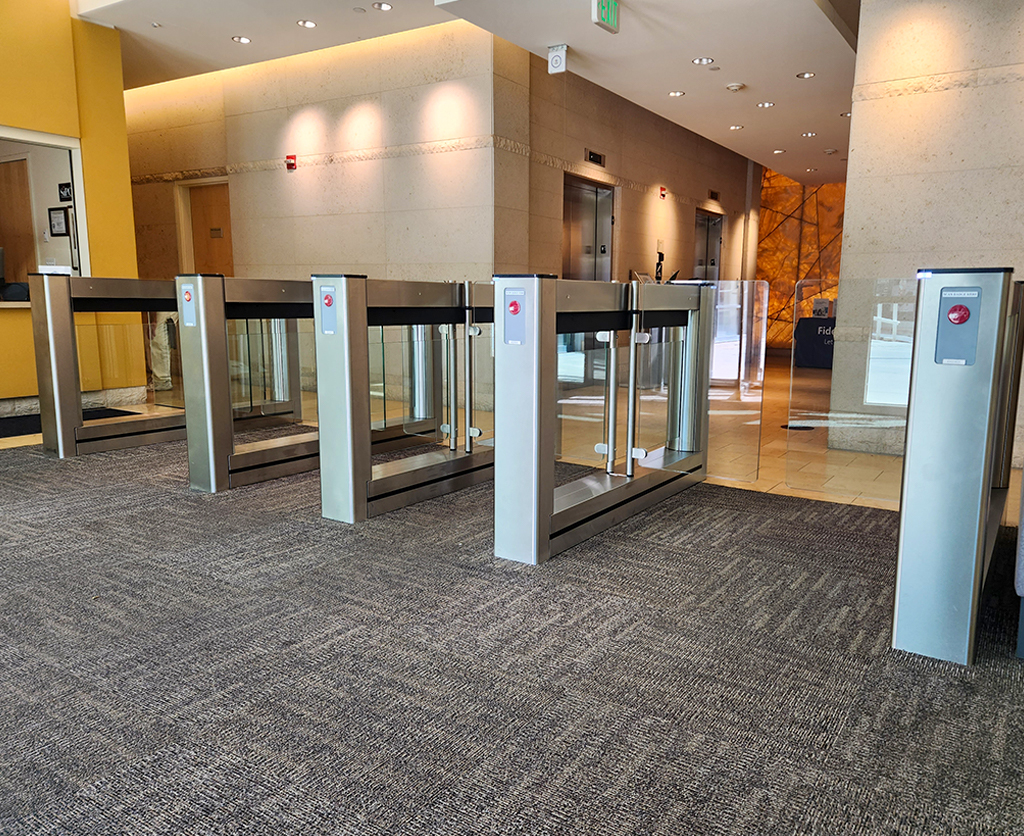
Specifying optical turnstiles for enterprise buildings means defining the detection accuracy, throughput, integration protocols, durability, and total cost of ownership your facility requires before an integrator sources equipment.
Key Takeaways: How to Specify Optical Turnstiles for Enterprise
- Detection accuracy varies dramatically between manufacturers—look for systems with less than ¼-inch tailgate detection to prevent unauthorized entry.
- Throughput specifications should match your peak traffic demands, with high-performance speed gates processing up to 60 people per minute per lane.
- Integration with your existing access control platform requires checking for standard protocols like Wiegand, OSDP, and TCP/IP connectivity.
- Fastlane® optical turnstiles from Smarter Security offer neural network technology that identifies individual dimensions and velocities to minimize false alarms.
- Total cost of ownership depends on cycle ratings, warranty coverage, and ongoing support—not just the initial purchase price.
Which Fastlane models meet enterprise specifications?
Fastlane® optical turnstiles from Smarter Security are specified by requirement, not by lobby size. Here are five examples of how common enterprise specifications map to specific models.
| Specification requirement | Fastlane model | What it delivers |
|---|---|---|
| Class A lobby, mid-height glass, concealed sensors | Fastlane Glassgate 150 Plus | Lanes up to 39.4″ (1000 mm). Neural-network detection with sensors hidden in the pedestal. |
| Retrofit of an existing Glassgate 150 installation | Fastlane Glassgate 150 LX | Bolt-for-bolt compatible with the original Glassgate 150 footprint. No floor work. |
| Taller barriers for financial or government contractor sites | Fastlane Glassgate 300 | 9.4″ (240 mm) pedestal with glass barriers to 70.9″ (1800 mm) high. |
| Wide lane with side-by-side detection | Fastlane Glassgate 155 | Lanes up to 47.25″ (1200 mm) with Sidegate Detection®, which catches two people passing through one lane together. |
| Verified single-person passage | Fastlane Interlock | Two interlocking barrier sets. Only one opens at a time. |
All Fastlane optical turnstiles are rated at 60 people per minute per lane with ¼” tailgate detection and a 10,000,000-cycle life. The full lineup is on the Fastlane turnstiles and speed gates page. For a model-by-model walkthrough, see 7 Fastlane optical turnstiles for corporate lobbies.
 What Are Optical Turnstiles and Speed Gates?
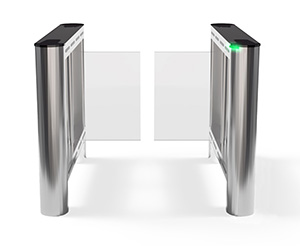
Optical turnstiles and speed gates are intelligent entrance control devices that regulate pedestrian traffic in commercial, government, and institutional lobbies. Unlike traditional tripod or waist-high mechanical turnstiles, optical turnstiles use infrared sensor arrays to detect unauthorized entry attempts while allowing smooth passage for authorized individuals.
These systems integrate with your building’s access control platform to verify credentials—whether badge, biometric, or mobile—before granting entry. When someone attempts to follow an authorized person without presenting valid credentials, the system detects this tailgating attempt and triggers an alarm or physical barrier response.
Speed gates specifically refer to optical turnstiles equipped with motorized glass or panel barriers that open and close rapidly. You’ll find them in corporate headquarters, financial institutions, healthcare facilities, government buildings, and data centers where both security and aesthetics matter.
Why Specification Matters for Enterprise Optical Turnstiles
Selecting the wrong optical turnstile specification can leave your facility vulnerable to unauthorized entry or create frustrating bottlenecks during peak traffic hours. Not all turnstiles perform equally—detection accuracy, throughput capacity, and integration capabilities vary significantly between manufacturers and models.
A specification document ensures your security integrator or general contractor sources equipment that actually meets your operational requirements. It establishes clear performance benchmarks that can be verified during commissioning and protects you from products that look similar on the surface but deliver vastly different security outcomes.
Enterprise facilities face unique challenges: high-volume traffic during shift changes, complex visitor management workflows, integration with existing access control infrastructure, and architectural requirements that demand premium finishes. Your specification must address each of these factors explicitly.
How to Evaluate Tailgate Detection Accuracy
Tailgate detection is the core function of any optical turnstile. This specification determines how closely an unauthorized person can follow an authorized user before the system detects and responds to the intrusion attempt.
Detection accuracy is measured in inches or millimeters. Budget turnstiles using basic “beam-break” technology may miss tailgaters by 4 to 5 inches behind an authorized user, since simple infrared beams only register presence, not precise positioning.
Fastlane® turnstiles take a fundamentally different approach. Using neural network processing and multi-microprocessor intelligence, the optical sensors continuously analyze individual dimensions, contours, and velocities of everyone moving through the lane. This allows Fastlane® to detect tailgating down to less than ¼ inch—a level of precision conventional beam-break systems can’t approach.
That ¼-inch accuracy dramatically reduces the window of opportunity for unauthorized entry, making it far harder for a determined intruder to slip through behind an authorized user.
What Throughput Specifications Should You Require?
Throughput measures how many people can pass through a single turnstile lane per minute during normal authorized operation. This specification directly impacts how many lanes you need to prevent queuing during peak arrival times.
Calculate your peak traffic by identifying your busiest 15-minute window—typically morning arrival or shift changes. If 300 employees arrive between 8:45 and 9:00 AM, you need turnstile capacity to handle 20 people per minute minimum. Adding a safety margin for visitors, contractors, and growth means specifying higher throughput capacity.
High-performance optical turnstiles process up to 60 people per minute per lane. Lower-end models may handle only 25–30 people per minute. The difference means you might need two lanes instead of four—significantly impacting your equipment budget and lobby floor space requirements.
How Does Barrier Type Affect Throughput?
Barrier configuration directly influences throughput speed. Barrier-free optical turnstiles (which rely solely on alarms) offer the highest throughput but the lowest physical deterrence. Glass barrier speed gates balance security with throughput, while full-height turnstiles offer high security but at reduced throughput rates.
Swinging glass barriers represent the most popular choice for enterprise lobbies. They offer both physical deterrence and rapid operation. The best models use tempered and laminated glass for safety, opening quickly enough to maintain high throughput while indicating a clear physical boundary.
How to Specify Access Control Integration Requirements
Your optical turnstiles must communicate with your existing access control platform to verify credentials and log entry events. Integration specifications ensure compatibility and prevent costly rework during installation.
Standard integration protocols include Wiegand (the legacy industry standard), OSDP (the modern encrypted protocol), and relay-based dry contact connections. TCP/IP connectivity helps with network-based configuration, monitoring, and control—essential for multi-site enterprises managing turnstiles remotely.
Fastlane® systems connect with biometric readers, mobile and QR code scanners, elevator dispatch displays, and third-party access control platforms. Fastlane Connect IP allows remote monitoring and control, letting your security operations center manage turnstile status across multiple facilities from a central location.
What Credential Types Should Your Turnstiles Support?
Modern enterprise security increasingly relies on multiple credential types beyond traditional proximity cards. Your specification should require support for RFID cards, smart cards, mobile credentials, QR codes, and biometric readers.
Consider future requirements as well. Many organizations are migrating from legacy card technologies to mobile credentials or facial recognition. Specifying turnstiles with universal reader mounting options and standard communication protocols protects your investment as credential technologies evolve.
How to Evaluate Build Quality and Durability Specifications
Optical turnstiles operate continuously in high-traffic environments. Build quality specifications predict long-term reliability and total cost of ownership over the equipment’s lifespan.
Cycle rating indicates how many open-close operations the turnstile mechanism can perform before requiring major maintenance or replacement. Premium systems are built to exceed 10 million cycles of operation—representing decades of service in most applications. Lower-quality units may fail after just 2–5 million cycles.
Housing material matters for both durability and appearance. Grade 304 stainless steel with a brushed finish resists corrosion and maintains its appearance in high-traffic environments. Avoid units using thin-gauge steel or plastic components that will show wear quickly.
What Safety Features Should You Specify?
Turnstile barriers move rapidly and must include safety features to prevent pedestrian injury. Glass barriers should be precisely programmed to prevent contact with all pedestrians, including children and guide animals who may not be detected at adult sensor heights.
Emergency fail-safe operation should open barriers automatically during fire alarm activation or power failure, ensuring safe egress during emergencies.
How to Specify Aesthetic and Architectural Requirements
Enterprise lobbies serve as the first impression for employees, visitors, and clients. Your turnstile specification should address finish options, dimensions, and customization capabilities to ensure the equipment complements your architectural vision.
Standard finishes typically include brushed stainless steel, which creates a clean, modern foundation. Premium options include other metal finishes, powder-coat colors, and top finishes in wood or stone materials. These customization options allow each installation to reflect the brand and architecture of the facility.
Dimensions vary significantly between models. Specify maximum pedestal width and length to ensure the equipment fits your floor plan. Some manufacturers offer multiple pedestal sizes within the same product family, allowing you to maintain visual consistency while addressing varying lane width requirements.
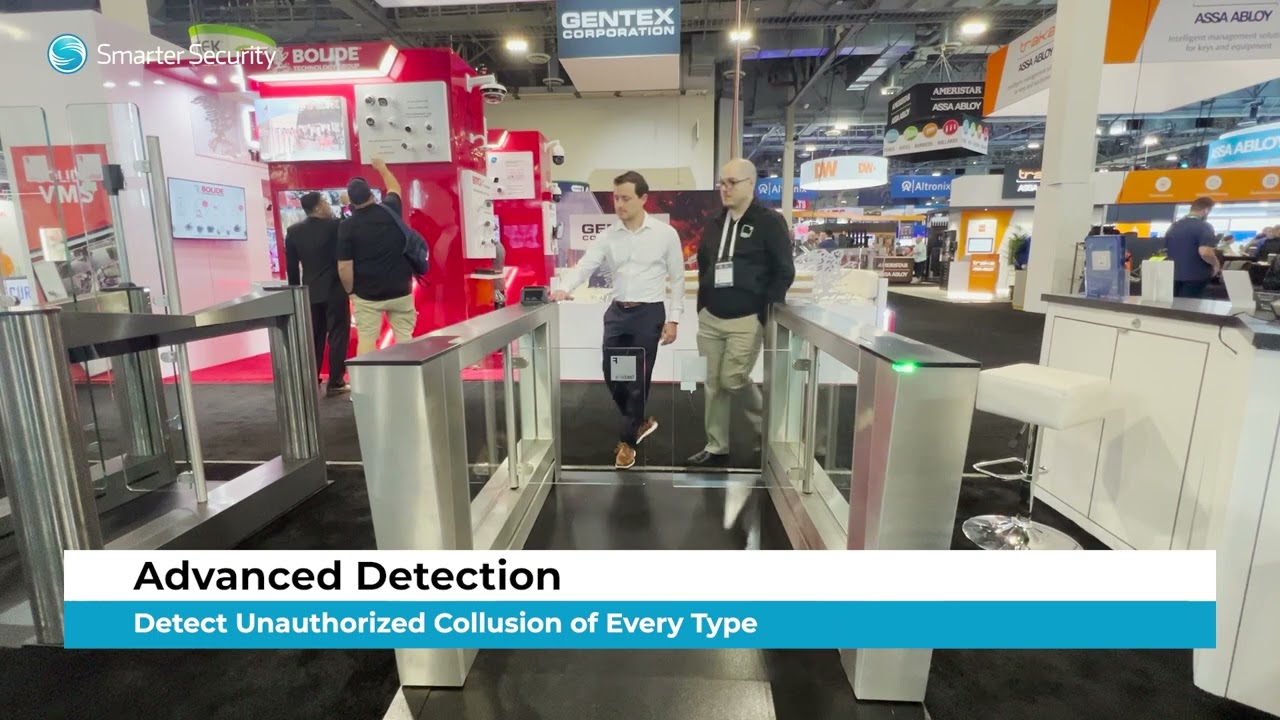
Wider lane configurations deserve particular attention in your specification. Going beyond the standard 36-inch ADA-compliant clear width, wider lanes provide additional clearance for wheelchairs and mobility devices, and can also support throughput planning. However, that added width introduces a specific vulnerability: two people walking through side-by-side.
This is where Sidegate Detection® becomes essential. Using the same neural network processing and multi-microprocessor intelligence behind Fastlane’s ¼-inch tailgate detection, Sidegate Detection® instantly identifies side-by-side collusion attempts in wider lane models. This capability is exclusive to wider Fastlane® lanes—no other manufacturer offers equivalent side-by-side detection in wider configurations.
How to Specify Infill Panels and Perimeter Closure
Infill panels close the gaps between turnstile lanes and surrounding walls or barriers. Without proper infill, people can simply walk around the turnstiles rather than through them—defeating the entire purpose of your entrance control system.
Specify infill panels that match your turnstile finish and style. Glass infill panels maintain visual openness while creating a physical barrier. Height options typically range from waist-height to full-height depending on your security requirements and aesthetic preferences.
Consider ADA swing gates for accessible entry points. These motorized gates cover the required 36-inch minimum clear width for wheelchair access while maintaining the same detection and integration capabilities as standard turnstile lanes.
What Network and Monitoring Capabilities Should You Require?
Modern optical turnstiles function as IP-based devices on your network, creating real-time status information and remote management capabilities. Network connectivity specifications determine how effectively you can monitor and manage your entrance control system.
Require TCP/IP connectivity with browser-based configuration interfaces. This allows your security team to adjust settings, update firmware, and troubleshoot issues without physical access to each unit. For multi-site enterprises, this capability is essential for efficient operations.
Real-time population data and audit trails support compliance requirements and emergency response procedures. Your turnstiles should maintain logs of all entry and exit events and the ability to export data for analysis and reporting.
How to Evaluate Warranty and Support Requirements
Warranty coverage and ongoing support significantly impact your total cost of ownership. Specify minimum warranty terms and verify what support services are included versus charged separately.
Premium manufacturers offer warranty programs extending up to ten years, backed by lifetime remote support and 24/7 phone assistance. This level of support ensures your turnstiles remain operational with minimal downtime throughout their service life.
Ask about preventative maintenance programs that include scheduled inspections, cleaning, and component replacement before failures occur. Site certification and training services help maximize product performance and ensure your security staff understands proper operation and basic troubleshooting.
How to Plan Your Optical Turnstile Installation
Successful turnstile deployment requires coordination across multiple disciplines: security, facilities, IT, and often architectural teams. Planning begins well before equipment selection.
Conduct a site security assessment to determine the appropriate security level for each entrance point. High-security areas may require full-height turnstiles or dual barrier interlock configurations, while general lobbies may use standard speed gates with glass barriers.
Review floor plans to identify optimal turnstile placement that maintains traffic flow while preventing bypass. Consider electrical and network infrastructure requirements, as turnstiles require power and data connections at each lane position.
What Role Do Security Integrators Play?
Your integrator should coordinate with the turnstile manufacturer for proper installation, testing, and commissioning. Look for manufacturers that offer installation support services and site certification programs to ensure your equipment is configured correctly and performing to specification.
If you’re not sure where to start, contact the turnstile supplier directly. Manufacturers typically work with a network of integrators experienced in their specific products and can recommend a reputable integrator in your area.
Common Specification Mistakes to Avoid
Specifying based solely on initial price often leads to a higher total cost of ownership when equipment fails prematurely or requires frequent maintenance. Evaluate lifecycle costs, including energy consumption, maintenance requirements, and expected service life.
Underestimating throughput requirements creates bottlenecks and frustration. Plan for growth and worst-case peak traffic scenarios, not just current average conditions.
Ignoring integration complexity causes installation delays and cost overruns. Verify compatibility with your specific access control platform before finalizing your specification, not during installation.
Overlooking future-proofing leads to costly rework down the line. Credential technologies evolve quickly, and your turnstiles should be able to adapt without requiring a full equipment replacement. Specify pedestal tops and reader mounting that allow third-party credential readers to be swapped out easily as technology changes.
FAQs About How to Specify Optical Turnstiles for Enterprise
What is the difference between optical turnstiles and speed gates?
Optical turnstiles use infrared sensors to detect unauthorized passage and may or may not include physical barriers. Speed gates specifically refer to optical turnstiles with motorized barriers that open and close rapidly. Fastlane® speed gates from Smarter Security combine advanced optical detection with glass barriers for enterprise environments.
How many optical turnstile lanes do I need?
Calculate your peak traffic demand by identifying the busiest 15-minute arrival window. Divide the number of people by 15 to get required throughput per minute, then divide by your chosen turnstile’s rated capacity per lane. Always add 20–30% capacity buffer for growth and unexpected peak demand.
What access control systems do optical turnstiles integrate with?
Fastlane® optical turnstiles from Smarter Security integrate with most major access control platforms using standard protocols including Wiegand, OSDP, and TCP/IP. Compatible credential types include proximity cards, smart cards, mobile credentials, QR codes, and biometric readers.
How long do optical turnstiles last?
Premium optical turnstiles built to exceed 10 million cycles can last 15–20 years or more in typical enterprise environments. Cycle ratings, housing materials, and warranty coverage are the key durability indicators to evaluate during specification.
What is Sidegate Detection® and why does it matter?
Sidegate Detection® is an exclusive capability in wider Fastlane® lanes that uses neural network processing to detect two people attempting to pass side-by-side through a single lane. Standard optical turnstile sensors designed for single-file traffic cannot reliably identify this collusion tactic in wider lane configurations.



