
An employee walks through the lobby turnstile dragging or carrying a large box or bag, and the alarm fires. Guards look up. There is no second person, just an object the sensor read as a body. No badge problem, no threat, just a false alarm that eroded a little more trust in the system. Multiply that by dozens of alerts per shift and you get alarm fatigue: staff stop taking alerts seriously, and the one real tailgating event gets treated like the rest.
The fix is not louder alarms. It is more precise detection, and precision comes down to the intelligence inside each lane. Whether the turnstile runs on a single controller working one job at a time, or on distributed processors working in parallel. That one architecture choice decides your false-alarm rate, your throughput, and the odds that a real tailgater slips through.
This guide covers how neural-network analytics change tailgating detection, and how to tell a genuinely intelligent lane from one that only looks the part. For the full architecture story, our companion white paper, What Makes a Turnstile Intelligent?, breaks down the distributed neural-network design inside every Fastlane® lane.
What you’ll learn in this article
- What separates an intelligent turnstile from a single-controller lane that only looks the part
- How PLC, Time-of-Flight, LiDAR, and distributed CPU architectures compare in a real lobby
- What distributed neural-network processing does differently at the moment of detection
- The operational and financial cost of alarm fatigue, with numbers from deployed facilities
- How neural-network turnstiles fit into a layered access control architecture
The problem with traditional tailgating detection
Conventional optical turnstiles use infrared beam arrays to count bodies passing through a lane. A single beam break registers as one person, two as two. The real world does not cooperate so neatly, and that is where beam logic breaks down:
- A large bag or rolling luggage can trigger an extra beam break and read as a second person.
- Mobility aids and outerwear: a wheelchair, a cane, or a bulky coat can generate a signature that confuses the system.
- Close followers: two employees in close but legitimate succession look the same as a real tailgater.
The result is a binary trap. Turn sensitivity up, and you catch tailgaters along with a flood of innocent employees. Turn it down, and you open gaps a real tailgater can exploit. Neither setting is right, because beam-array logic was never built to make the distinction. If you are weighing where beam counting ends and detection begins, our blog on tailgating vs. piggybacking lays out the behaviors these systems have to tell apart. When Pacific Gas & Electric upgraded its San Francisco lobbies, video review found employees had been routinely stepping over or pushing open glass barrier gates, none of which tripped a meaningful alert under the old sensor logic.
What makes an optical turnstile “intelligent”?
Intelligence in an optical turnstile is not the glass or the pedestal. It is the processing inside each lane: how many processors are doing the thinking, and whether they work one job at a time or all at once. A basic lane counts beam breaks and guesses. An intelligent lane builds a live model of everyone and everything in the lane, tells a person from a bag, and clears an authorized user the instant the decision is made. In a Fastlane lane, that runs across a network of processors making thousands of calculations per second, modeling the whole lane in real time.
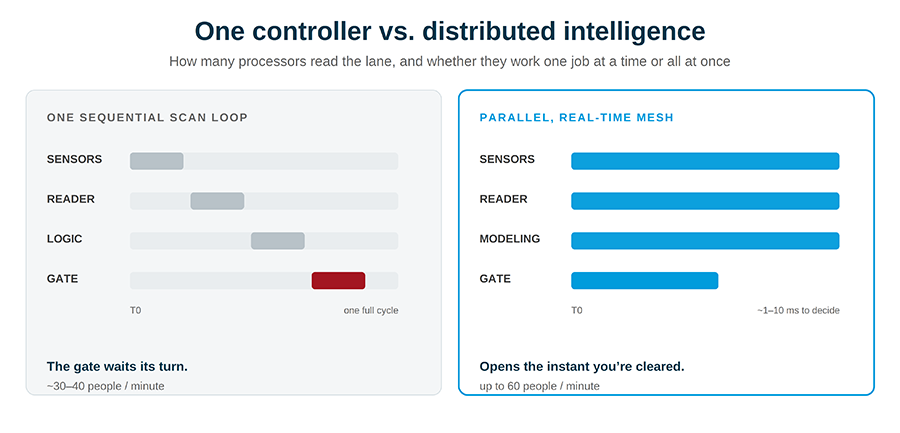
A single controller runs one sequential loop; distributed intelligence runs every function in parallel.
Why turnstile architecture decides your false-alarm rate
The false-alarm rate is set by an architecture decision made long before install: what kind of processor reads the lane, and how many of them work at once.
The takeaway is not simply CPU versus PLC. A single controller, whether a PLC or one embedded CPU, works its jobs in sequence, and detection thins exactly when the lane gets busy. A distributed lane runs detection, object modeling, and barrier motion at once, returns a confidence-scored decision in roughly one to ten milliseconds, and degrades gracefully if one processor faults instead of dropping the whole lane.
| Approach | How it reads the lane | In a busy lobby |
|---|---|---|
| PLC | Fixed if/then rules | No sense of probability; every rule is manual |
| Infrared line break | Logs beam interruptions only | Binary. Cannot tell a bag from a body; most nuisance alarms start here |
| Time-of-Flight | Adds a depth map of the lane | Marble, glass, and bright light scatter the signal and degrade it |
| LiDAR | 3D laser point cloud | High cost and mounting; data volume adds latency |
| Distributed CPU (Fastlane) | Multiple processors model every object in parallel | Sharp under load; confidence-scored, not binary; fewer false alarms |
What neural-network analytics actually do
Instead of counting beam breaks, a trained model learns what a legitimate entry looks like and what tailgating looks like. Three capabilities do the work:
- Multi-sensor fusion: infrared arrays, depth sensors, and optical imaging feed one model at once, so the question shifts from “how many beams broke?” to “what just happened in this lane?”
- Gait and trajectory analysis: directional movement, entry speed, body separation, and timing separate a close-but-legitimate follower from someone slipping through behind a credential holder.
- Object differentiation: the model binds a pushed or pulled bag to its owner and flags a genuine second body, resolving a follower to under a quarter-inch (5 mm). In wider lanes, that same modeling powers Sidegate Detection® for two people moving through side by side.
The false-alarm math
A mid-size building might see 1,500 entries a day through four lanes. At a traditional false-alarm rate, that is 30 to 60 nuisance alerts daily, enough to normalize the alarm sound entirely. Neural-network detection drops false positives sharply while holding or improving accuracy, so alerts mean something and guards respond decisively. The operational case follows, from a Class A high-rise on Chicago’s Wacker Drive:
- Before: 7 officers at peak, stationed at elevator bays to watch badge scanning
- After: 3 officers at the desk, entry automated by Fastlane Glassgate 200 turnstiles
- Payback: 20 months · 5-year savings $779,000 · 262% ROI at five years
PG&E saw the same pattern, saving more than $250,000 a year once its San Francisco lobby reached a fully self-managed entry point. Three bigger numbers sit behind the staffing math:
- $4.07M: the average breach that starts with a physical-security failure, per a figure cited in our white paper. A single tailgater is exactly that failure.
- Shorter lines at peak: a Fastlane lane clears up to 60 people per minute versus 30 to 40 for a single-processor lane, so the morning rush clears without the line backing up into the lobby.
- Reclaimed hours: fewer nuisance alarms give back guard time that approximate systems burn on false alerts.
The white paper includes a back-of-envelope ROI worksheet you can re-run with your own traffic, labor rate, and alarm counts.
When distributed intelligence actually matters
Not every entryway needs a network of processors. Match the lane to the entrance.
A simpler single-controller lane is fine when:
- security and traffic are both low
- close-follow tailgating is not a real threat
- an occasional nuisance alarm is a minor annoyance
Distributed intelligence earns its place when:
- detection has to stay sharp during peak flow
- throughput cannot afford a hesitating gate
- a false alarm every few minutes would train guards to stop looking
- accuracy and speed all have to be true at once
High throughput is non-negotiable
Fastlane optical turnstiles are purpose-built for pedestrian flow. Because the distributed processors run detection, decision, and motion at the same instant, a cleared user is not waiting on unrelated work: the gate opens the moment you are cleared, not after the loop comes back around. Detection happens during entry, not instead of it.
At 55 Hudson Yards, a 51-story tower processing hundreds to thousands of entries a day, the answer was 16 lanes of Fastlane Plus 400 MA turnstiles integrated with IDEMIA‘s MorphoWave® touchless fingerprint authentication at the point of entry. As Brad Stewart of The Related Companies put it: “We needed to find a way to process high volumes of personnel through the lanes to reduce queue buildup within the lobbies.”
Read the 55 Hudson Yards case study →
At the University of Notre Dame, Fastlane Glassgate 150 turnstiles replaced staff manually swiping student cards at a busy dining hall where lines ran outside even in Indiana winters. Entry speed increased ten-fold and outdoor queuing disappeared.
Read the Notre Dame case study →
Where neural-network turnstiles fit in a layered security model
No single control is a complete solution. Optical turnstiles are a strong perimeter layer, and their value multiplies when the events feed the rest of the stack:
- Access control: a tailgating event becomes a timestamped alert tied to the credential, via Wiegand, OSDP, or API.
- Video surveillance: the trigger auto-bookmarks footage in the VMS, so the alert and the evidence arrive together.
- Visitor management: the lane verifies a visitor against an expected credential event and flags anomalies. Fastlane turnstiles as well as Door Detective® also have built-in population counting, tracking real-time occupancy by zone and building-wide, which gives responders an accurate headcount during an evacuation and lets building automation systems trim energy use in near-empty zones.
- Fire and life safety: barriers release instantly in an emergency, while still distinguishing a controlled exit from an unauthorized entry.
- Alarm management: fewer nuisance events mean cleaner data and a truer picture of entrance posture over time.
For a wider view of how these layers work together, see our guide to the 6 types of unauthorized access.
Common deployment questions
What is the difference between a single-controller turnstile and a distributed-intelligence turnstile?
A single-controller lane, whether a PLC or one embedded CPU, handles detection, decision, and motion in one repeating loop, one job at a time. Detection quality drops as the lane gets busy, and if the controller faults, the whole lane goes down. A distributed-intelligence lane runs multiple processors as a neural network, handling those jobs in parallel and degrading gracefully if one faults. The result is sharper detection under load, higher throughput, and far fewer nuisance alarms.
Do neural-network turnstiles require expensive infrastructure upgrades?
Not necessarily. Many are software-layer additions to existing hardware, or built into newer models that replace aging barrier gates one lane at a time. PG&E replaced its original Fastlane Glasswing turnstiles, nine years old and still mechanically sound, over a single weekend, fully operational by Monday morning.
What if our building has strict design or structural requirements?
PG&E’s San Francisco headquarters is a designated historical landmark. The Fastlane Glassgate 200 installation required only six bolts per pedestal into the marble, covered by the pedestal, while maintaining the building’s LEED Platinum Certification. Design constraints are real, and solvable.
Learn more about Fastlane customization options →
How does the system handle edge cases like mobility devices, large groups, or service personnel?
This is where trained models beat rules-based logic. Service carts, mobility devices, and group movement are scenarios neural networks are specifically trained on. During installation, a security consultant works with the facility to assess its security needs and configure the expected exceptions, adding wider-lane turnstiles or an access gate like the Fastlane Passgate 300 or Intelligate 300 so known edge cases clear cleanly.
What happens when the neural network is wrong?
Detection confidence thresholds are configurable. High-security areas can trigger alerts sooner; high-traffic lobbies can raise the threshold to reduce disruption. The output is a confidence score, not a binary trigger, so teams tune it to their own risk tolerance.
Is the data from these systems considered biometric?
It depends on the implementation. Gait and trajectory analysis without facial recognition or stored biometric templates typically falls outside biometric data regulations, but legal and compliance teams should confirm jurisdiction-specific requirements. Biometric integration, as at 55 Hudson Yards, is an addition to the platform, not a requirement.
Why Smarter Security
We are focused on one problem: how do you control who enters a building without a security-theater experience that frustrates real users and misses real threats? That focus has taken us inside some of the most demanding physical security environments in the Americas: Fortune 100 headquarters, critical infrastructure, major university campuses, and landmark commercial towers.
Distributed neural-network analytics in Fastlane® optical turnstiles resolve a follower to under a quarter-inch while holding throughput at up to 60 people per minute. When detection is that precise, the staffing math improves, the alarms mean something, and the security program earns credibility with the rest of the business.
Go deeper: the distributed-intelligence white paper
Want the full architecture breakdown? Download What Makes a Turnstile Intelligent? for the distributed neural-network deep dive, the three benefit pillars (detection, speed, and precision), and an ROI worksheet you can run on your own numbers.
Download the white paper: What Makes a Turnstile Intelligent? →
Smarter Security is the exclusive provider of Fastlane® optical turnstiles and Door Detective® entrance control solutions across the Americas.
Fastlane optical turnstiles | Door Detective | Download the white paper | Contact us


