

How Turnstiles Improve Security
in Healthcare Facilities
The safety and security of healthcare facilities are critical — and increasingly complex. Hospitals welcome patients, staff, and visitors around the clock, making controlled access both essential and challenging. Turnstiles help healthcare facilities manage who enters and exits, reducing security risks while maintaining a welcoming environment for those who belong there.
What Are the Biggest Security Challenges in Healthcare Facilities?
With the vulnerability of patients and sensitivity of the information and materials housed within, hospitals and clinics face a range of security threats; from unauthorized access, patient abduction, theft of medical supplies or drugs, to data breaches. These facilities must balance the efficient entry access needed with the stringent security required to protect people and private spaces. Healthcare institutions, thus, require robust and effective security systems to mitigate these risks.
Secure access control systems are essential in healthcare environments to prevent unauthorized entry and ensure that only authorized personnel have access to sensitive areas. The presence of a reliable access control system acts as a deterrent against potential intruders and ensures that all areas are adequately monitored and controlled. This reduces the likelihood of internal and external theft, potential contamination, and ensures that safety protocols are strictly followed.
What Are the Benefits of Using Turnstiles in Hospitals?
Turnstiles are a type of gate that allows one person to pass at a time and can restrict passage to those who aren’t authenticated via credentials, registration, a pass, or similar. In healthcare settings, turnstiles are employed to enhance the management of site security by controlling pedestrian movement into and out of the premises. They serve multiple functions, including visitor management, employee access control, and as a barrier to restrict entry to certain sensitive areas like neonatal units, psychiatric wards, or pharmacies within the hospital.
Utilizing turnstiles in hospitals offers several benefits:
- Regulated Entry: They provide a physical barrier that regulates entry, ensuring only authorized individuals can access restricted areas.
- Enhanced Security: Turnstiles are an effective deterrent against unauthorized access, reducing potential security breaches.
- Traffic Flow Management: They efficiently manage high volumes of people entering and exiting, maintaining an orderly flow of traffic without bottlenecks.
- Integration with ID Systems: Turnstiles can be integrated with badge readers and biometric systems, enhancing the effectiveness of the security infrastructure.
- Cost-Effective: By reducing the need for manual security checks, turnstiles can lower operational costs over time.
The adoption of turnstiles in healthcare settings, therefore, not only strengthens security measures but also improves the overall operations of healthcare facilities.

What Access Control Solutions Are Best for Healthcare Settings?
Full-Height Turnstiles
Full-height turnstiles extend from floor to ceiling, providing maximum access control for areas requiring the highest level of security. Their robust design prevents tailgating and unauthorized entry even in high-traffic conditions — making them ideal for restricted back-of-house areas in hospitals.
Optical Turnstiles (Waist-Height)
Optical turnstiles offer a more open, welcoming aesthetic without sacrificing security. Well-suited for main lobbies and administrative areas, they manage large volumes of people efficiently and integrate seamlessly with card reader and biometric systems. Their sleek design fits the professional environment most healthcare facilities want to project.
Door Detective — Anti-Tailgate Door Security
For interior rooms where a turnstile isn’t practical, door-mounted access control fills the gap. The Door Detective is a door-mounted anti-tailgate device designed to secure individual rooms and interior access points. It monitors directional violations, detects tailgating, and tracks occupancy in real time — ensuring one person enters per credential. The Door Detective is ideal for high-risk interior spaces like medication rooms, supply storage, and server rooms where access control is non-negotiable.
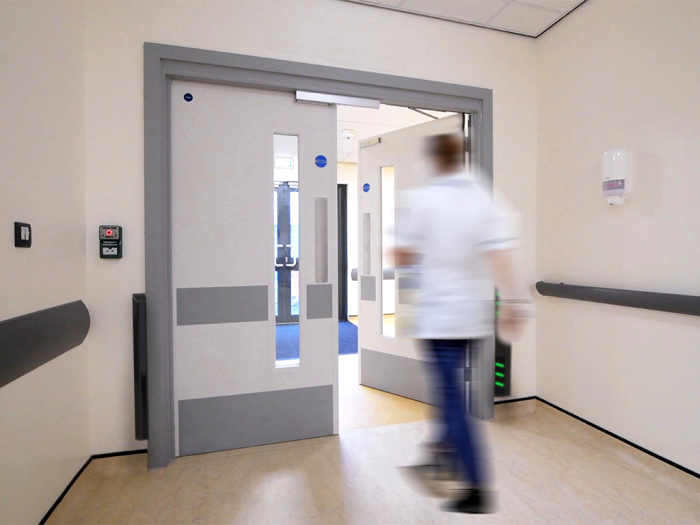
Pictured Here: Door Detective SG managing double doors for hospital security
Why Are Turnstiles a Smart Investment for Hospital Security?
Turnstiles do more than manage crowds — they are a core component of a healthcare facility’s overall security infrastructure. By controlling access at critical entry points, turnstiles ensure that only authorized individuals reach sensitive areas, significantly reducing both internal and external threats.
For hospitals and healthcare networks looking to strengthen physical security, optical turnstiles and door-mounted access control devices like the Door Detective represent a proven, scalable investment — one that protects patients, staff, visitors, and the resources that make quality care possible.
This article was reviewed for accuracy by Executive VP of Smarter Security, Clayton Brown
Clayton Brown serves as Executive Vice President at Smarter Security, the exclusive provider of Fastlane® optical turnstiles and Door Detective® entrance control solutions throughout the Americas. As a member of SIA’s Government Relations Committee and Data Privacy Board, Clayton proudly represents a next-generation of practitioners dedicated to bringing data-driven ideas to existing physical security challenges.



