
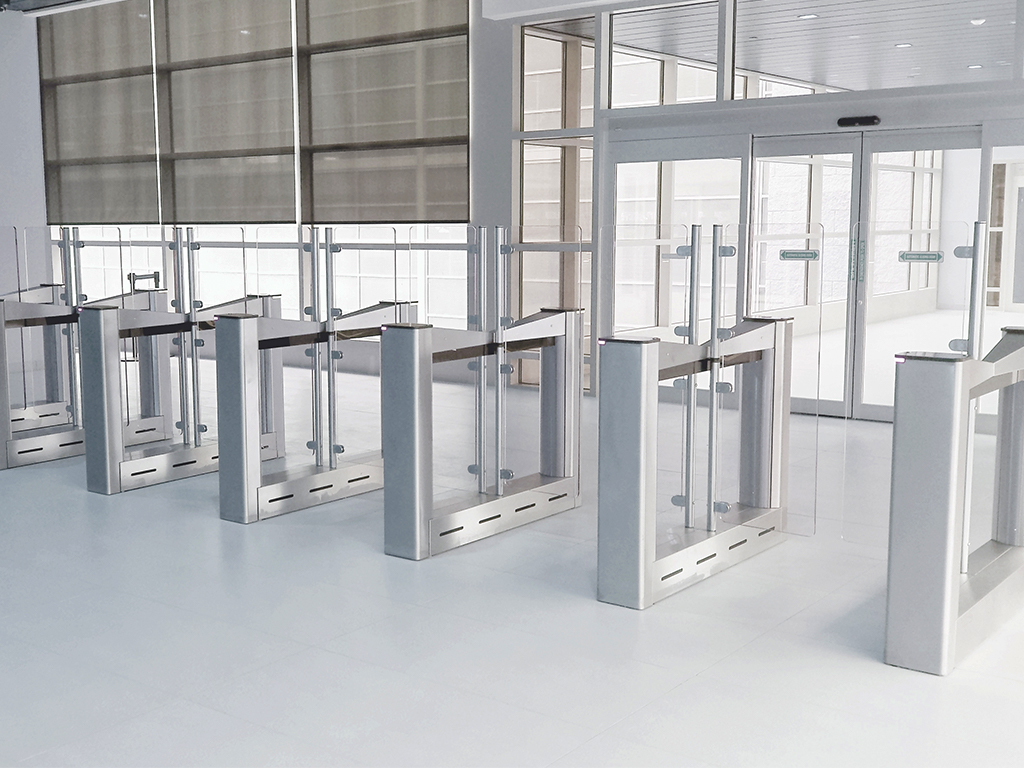
When it comes to securing your building’s entry points, choosing the right turnstile is one of the most important decisions a facility manager or security director can make. The wrong choice can create friction for your employees, frustrate visitors, and leave security gaps you didn’t anticipate. The right choice becomes nearly invisible — it just works, day after day, keeping unauthorized people out while letting authorized ones flow through effortlessly.
Two of the most common options you’ll encounter are optical turnstiles and full-height turnstiles. Both serve the same fundamental purpose, but they’re built for very different environments, user experiences, and security profiles. Here’s what you need to know to make the right call for your facility.
What Are Optical Turnstiles?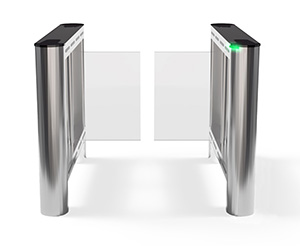
Optical turnstiles — sometimes called speed gates or optical lanes — use infrared sensors and retractable glass or acrylic barriers to monitor and control pedestrian access. Rather than solely relying on a physical barrier that requires force to breach, they use detection technology to identify tailgating and unauthorized entry attempts, triggering alarms when a violation is detected.
Because they’re sleek, low-profile, and designed for high-traffic environments, optical turnstiles are the preferred choice for lobbies where aesthetics matter as much as security. Think main lobbies, reception areas, executive floors, and visitor-facing entry points — spaces where you want to project a professional, welcoming image while still maintaining rigorous access control.
Smarter Security’s Fastlane Glassgate 150 or Glassgate 150 Plus is a strong example of what modern optical turnstiles can do. With its slim, architecturally refined design and advanced detection capabilities, it blends seamlessly into high-end lobby environments without sacrificing performance.
What Are Full-Height Turnstiles? 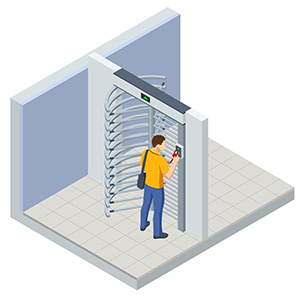
Full-height turnstiles are floor-to-ceiling mechanical rotating barriers that physically prevent passage until access is granted. They’re the traditional go-to for outdoor perimeter entries, loading dock access points, and unsheltered building entrances — locations where an imposing physical barrier has historically been the standard expectation.
That said, the gap between full-height turnstiles and modern optical solutions has narrowed significantly. Today’s optical turnstile technology has advanced to the point where many facilities that once defaulted to full-height models are finding that optical solutions can meet — and often exceed — their security requirements while delivering a far superior user experience.
Key Differences at a Glance
Security Level
This is where the conversation around turnstiles has changed the most in recent years. Optical turnstiles are no longer just detection-and-deter solutions. Modern configurations now include options like interlocking mantraps, which create a controlled vestibule that physically prevents passage until credentials are verified — effectively eliminating tailgating at the hardware level. Tall glass optical turnstiles with locking brakes add another layer of physical deterrence, stopping unauthorized entry in the vast majority of attempted breaches. Smarter Security’s barriers are engineered to withstand 300N of force applied for up to 12 hours without failure — a level of physical resilience that closes the gap with traditional full-height solutions for most indoor environments. For most lobbies, interior access points, and climate-controlled entry areas, today’s optical turnstiles deliver security performance that is more than sufficient — and in many cases comparable to full-height alternatives — without the imposing aesthetic or throughput limitations.
Full-height turnstiles still hold an edge in outdoor perimeter applications where absolute physical prevention is the only acceptable standard. But for many facilities, that level of restriction is more than the environment requires.
Aesthetics and User Experience
Optical turnstiles are purpose-built for environments where first impressions matter. Their sleek, low-profile designs communicate professionalism and create a welcoming atmosphere for employees and visitors alike. Full-height turnstiles have evolved over the years — modern glass-enclosed models offer a more refined look than traditional metal-arm designs — but optical turnstiles remain the preferred choice when a seamless, open lobby experience is the goal. For main lobbies, reception areas, and high-visibility entry points, integration with the overall architectural aesthetic is often just as important a consideration as security performance.
Throughput
Optical turnstiles handle volume significantly better. A well-configured optical lane can process hundreds of people per hour without creating bottlenecks during peak entry times. Full-height turnstiles are slower by design — the rotation cycle takes more time, which creates congestion at busy facilities. For any organization with substantial daily foot traffic, this difference has real operational consequences.
Weather and Environment
Full-height turnstiles have the advantage in outdoor perimeter applications, where exposure to the elements demands ruggedized construction. Most optical turnstiles are designed primarily for indoor, climate-controlled environments such as lobbies and elevator vestibules.
ADA Compliance
Optical turnstile configurations are naturally more accommodating for individuals with disabilities, mobility devices, or large equipment, and accessible lane options integrate cleanly into the overall design. Smarter Security’s Fastlane Glassgate 150 Plus offers a comfortable 39.4” (1000 mm) lane width — ideal for elegant entrance control across a wide range of industries while fully meeting ADA standards. For facilities that need even wider lanes of up to 47.24” (1200 mm) combined with heightened security, the Glassgate 400 Plus delivers both — featuring four barrier height options and Sidegate Detection® technology to prevent side-by-side unauthorized entry even in wider lanes. Both models fulfill ADA standards in the US and Canada and maintain throughput of up to 60 people per minute. Download the Wider Lane Portfolio brochure to explore all three wider lane models in detail.
Full-height turnstiles, by contrast, present a more complex picture for ADA compliance. Their floor-to-ceiling rotating barriers are inherently inaccessible to individuals using wheelchairs, mobility aids, or other assistive devices. As a result, facilities that deploy full-height turnstiles are typically required to provide an alternative form of entry — such as a staffed gate, a swing door, or a separate accessible lane — to remain compliant with ADA regulations. This adds cost, requires additional space planning, and can create an inconsistent experience for users who must be redirected to a different entry point. It’s an important operational consideration when evaluating where full-height turnstiles fit within your overall access control strategy.
Cost and Long-Term Value
Optical turnstiles require a meaningful upfront investment, but the total cost of ownership calculation tells a more complete story. When you factor in lobby design impact, user experience, throughput efficiency, and integration flexibility, optical turnstiles deliver exceptional long-term value for most facilities.
So Which One Is Right for Your Facility?
For interior access points and controlled entry areas, optical turnstiles are the right answer — especially when configured with modern security enhancements like tall glass panels or locking brakes. They deliver the security performance your environment requires while protecting the user experience and aesthetic integrity of your space.
Choose optical turnstiles if:
- Your entry point is an indoor lobby, reception area, elevator bank transition, or other climate-controlled space
- Aesthetics, user experience, and throughput are important considerations
- You want advanced security configurations like mantraps, interlocks, or tall glass panels with locking brakes
- You’re integrating with a sophisticated access control or visitor management system
- You want a future-proof investment that grows with your security needs
Choose full-height turnstiles if:
- Your entry point is an outdoor perimeter, unsheltered building entrance, or exposed access point where physical prevention is the absolute, non-negotiable standard
- Aesthetics are entirely secondary to access control
- Your threat model specifically requires a solution that optical technology — even in its most advanced configurations — cannot address
When Full-Height and Optical Turnstiles Work Together
For many large or complex facilities, the answer isn’t choosing between full-height and optical turnstiles — it’s using both strategically as part of a layered security approach. Each solution has a natural role to play depending on where you are in the building.
Full-height turnstiles are well-suited for outdoor perimeter entries and building access points where the first line of defense needs to be robust and weather-resistant. Once inside, optical turnstiles take over — securing the transition from the lobby to elevator banks and internal floors, controlling who moves deeper into the building and who doesn’t.
This layered approach is where optical turnstiles truly shine, in part because of the rich third-party technology integrations they support. Optical turnstile lanes can be equipped with elevator dispatch displays that direct credentialed employees straight to their designated floor — eliminating crowded elevator lobbies, reducing wait times, and creating a seamless experience from entry to desk. It’s security that works with your building’s operations rather than against them.
A landmark example of this in action is the World Trade Center, where Smarter Security’s Fastlane optical turnstiles were integrated with elevator destination control systems, allowing tenants to badge in and be directed to their floor instantly. The result was a dramatic improvement in both security and the daily experience for thousands of tenants moving through the building. Read the World Trade Center case study to see how it all came together.
The Bottom Line
There’s no universal right answer — only the right answer for your facility. The best turnstile solution is the one that matches your security requirements, your user population, your environment, and your brand. Taking the time to evaluate those factors upfront will save you from costly mistakes and give you an access control solution that serves your organization for years to come.
Ready to explore your options? Contact the Smarter Security team to discuss which solution is the right fit for your facility — or browse our full lineup of Fastlane optical turnstiles to see what’s possible.
This article was reviewed for accuracy by the Director of Marketing, Shana McCoy
Shana McCoy is the Director of Marketing at Smarter Security, a leading North American distributor of Fastlane optical turnstiles and Door Detective entrance control solutions. With over a decade of experience in the physical security industry, Shana brings deep expertise in entrance control technology, serving clients across corporate, healthcare, education, and government sectors — including more than half of the Fortune 100. Her work spans product marketing, campaign strategy, and content development, with a focus on helping organizations make informed decisions about access control investments.



