

Piggybacking is one of the most persistent—and preventable—security vulnerabilities in any facility. It doesn’t require technical skills, hacking tools, or inside knowledge. All it takes is one authorized person holding a door open for someone who shouldn’t be there. And it happens hundreds of times a day in office buildings, hospitals, universities, and data centers across the country.
If your organization is serious about physical security, preventing piggybacking isn’t optional. Here’s what you need to know.

What Is Piggybacking in Security?
Piggybacking (also called tailgating) occurs when an unauthorized person follows an authorized individual through a secured entry point without presenting their own credentials. The difference between the two terms is subtle but worth noting:
- Tailgating typically refers to someone slipping through undetected, without the authorized person’s awareness.
- Piggybacking usually implies the authorized person knowingly allows someone to follow—often out of politeness or social pressure.
Both represent the same fundamental risk: a breach of your controlled access perimeter.
Why Piggybacking Is a Bigger Threat Than You Think
Most organizations invest heavily in cybersecurity, access control software, and surveillance systems—while leaving their physical entry points dangerously exposed. Piggybacking is the low-tech workaround that bypasses all of it.
The consequences can include:
- Theft of assets or intellectual property — An unauthorized visitor who gains access to your floor can walk out with equipment, documents, or data.
- Workplace violence — Unvetted individuals in restricted areas pose a direct safety risk to employees.
- Compliance violations — In regulated industries like healthcare, finance, and government, unauthorized access can trigger serious legal and regulatory consequences.
- Data breaches — Physical access to server rooms, workstations, or unattended screens can be just as damaging as a cyberattack.
According to security industry research, piggybacking accounts for a significant percentage of unauthorized physical access incidents—yet it remains widely underestimated as a threat vector.
How to Prevent Piggybacking: A Layered Approach
Preventing piggybacking effectively requires more than a policy. It requires the right combination of technology, design, and culture.
Deploy Optical Turnstiles at Key Entry Points
Optical turnstiles are one of the most effective and widely adopted tools for piggybacking prevention. Unlike traditional access control readers alone—which simply unlock a door—optical turnstiles enforce one-person-one-credential at the point of entry.
Fastlane® optical turnstiles use advanced infrared detection and neural network technology to distinguish between authorized and unauthorized passage attempts in real time. When a tailgating attempt is detected, the barriers respond instantly, and an alert is triggered. The result is a physical deterrent that works continuously, without relying on human judgment.
Modern optical turnstiles offer significant advantages over older full-height turnstile models:
- Higher throughput — Authorized users move through quickly, reducing congestion.
- ADA compliance — Wide-lane options accommodate wheelchairs, strollers, and assistive devices.
- Aesthetic integration — Sleek glass barrier designs fit modern architecture without creating a fortress feel.
- Scalability — Systems can be configured for low-traffic executive floors or high-volume main lobbies.
Use Anti-Tailgating Sensors at Doorways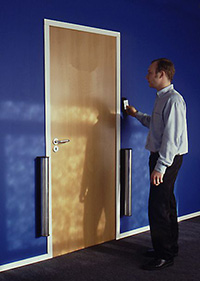
For controlled access doors where turnstiles aren’t practical, anti-tailgating sensors provide a smart alternative. Door Detective® uses advanced sensing technology to detect and alert when more than one person passes through a doorway on a single credential presentation—without restricting the flow of authorized users.
This is particularly effective for:
- Server rooms and data centers
- Restricted back-office areas
- Side or secondary entry doors
- Any doorway where a turnstile footprint isn’t feasible
Design Your Space to Discourage Piggybacking
Physical security design matters. A lobby or entry corridor that forces a single-file approach to access control is inherently more secure than a wide-open space where groups can bunch up together. Work with your security integrator and architect to:
- Create defined entry lanes that funnel traffic through controlled points
- Position reception desks with sightlines to all entry points
- Use signage and floor markings to set behavioral expectations
- Eliminate “social shortcut” routes that bypass security checkpoints
Train Employees and Set Clear Policies
Technology alone can’t solve a cultural problem. Employees need to understand that holding the door for an unverified person—no matter how uncomfortable it feels to say no—is a security violation, not a courtesy.
Effective training programs should:
- Explain what piggybacking is and why it matters
- Give employees language to use when confronted with a tailgating situation (“I’m sorry, everyone needs to badge in separately”)
- Establish a clear reporting process for suspected incidents
- Include piggybacking awareness in onboarding and annual security refreshers
Monitor, Alert, and Audit
Your access control system should do more than unlock doors. Integrate your turnstile and door detection systems with your security information platform to:
- Generate real-time alerts when tailgating is detected
- Log and review attempted breaches by location, time, and frequency
- Use video verification to review flagged events
- Identify patterns that indicate systemic vulnerabilities
Regular audits of entry point activity can reveal which locations are most vulnerable and where additional intervention is needed.
Optical Turnstiles vs. Full-Height Turnstiles: Which Prevents Piggybacking Better?
This is a common question—and the answer depends on your security environment and visitor experience priorities.
Full-height turnstiles create a near-impenetrable physical barrier. They’re ideal for high-security perimeters, outdoor installations, and environments where aesthetics are secondary to absolute access control. However, they’re slower, bulkier, and can feel unwelcoming in corporate or hospitality-oriented environments.
Optical turnstiles are the preferred choice for most commercial and institutional lobbies. They combine strong piggybacking deterrence with high throughput, modern aesthetics, and flexibility. With the right detection technology—like the neural network-enhanced infrared sensing in Fastlane systems—they detect and respond to tailgating attempts with high accuracy and minimal false alarms.
For most organizations, the right answer is optical turnstiles at primary lobbies, supplemented by door detection sensors at secondary access points.
The Cost of Doing Nothing
Many organizations delay piggybacking prevention because the risk feels abstract until something goes wrong. But the cost of a single incident—theft, a workplace violence event, a compliance audit failure—almost always exceeds the cost of the access control infrastructure that would have prevented it.
The question isn’t whether piggybacking prevention is worth the investment. The question is how long you’re willing to leave the door open.
Smarter Security: Entrance Control Built to Stop Piggybacking
Smarter Security distributes Fastlane optical turnstiles and Door Detective anti-tailgating solutions across the Americas.
Our team works with security integrators and end users to design entrance control systems that match your security requirements, architectural context, and budget.
Whether you’re retrofitting an existing lobby or designing a new facility from the ground up, we can help you close the gap that piggybacking exploits.
Ready to assess your entry points? Contact Smarter Security to speak with an entrance control specialist.
Ready to explore your options? Contact the Smarter Security team to discuss which solution is the right fit for your facility — or browse our full lineup of Fastlane optical turnstiles to see what’s possible.
This article was reviewed for accuracy by the Director of Marketing, Shana McCoy
Shana McCoy is the Director of Marketing at Smarter Security, a leading North American distributor of Fastlane optical turnstiles and Door Detective entrance control solutions. With over a decade of experience in the physical security industry, Shana brings deep expertise in entrance control technology, serving clients across corporate, healthcare, education, and government sectors — including more than half of the Fortune 100. Her work spans product marketing, campaign strategy, and content development, with a focus on helping organizations make informed decisions about access control investments.



