

High-security facilities spend serious money on enterprise access control solutions — software, cameras, credentials, personnel. And people still walk through who shouldn’t.
The problem usually isn’t the technology budget. It’s the entry point.
Pedestrian access control systems are where your security posture is either enforced or exposed. Here are the 10 most common ways they fail — and what to do about each.
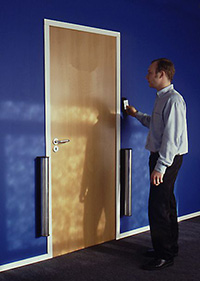 1. You’re Using a Door
A card reader on a door isn’t an access control system. It’s a locked door with a card reader. One credential can let in two people, and your software won’t know the difference — it only logs the badge, not the body count.
The Fix: Replace door-only entry points with dedicated entrance control. Optical turnstiles and speed gates physically enforce one-in, one-out in lobbies and elevator lobbies. For interior doorways — server rooms, restricted back-of-house access, data center floors — Door Detective® door-mounted monitoring devices enforce the same standards a turnstile does without lane infrastructure. The right tool depends on where the entry point is.
2. Tailgating and Piggybacking Are Going Undetected
Tailgating — someone following a badged employee through without credentialing — is the most common physical security breach in commercial facilities. Piggybacking, where an employee knowingly lets someone through with them, is the insider-risk version of the same problem. Both are happening at facilities that believe they’re secured. Most can’t prove either.
The Fix: Specify tailgating and piggybacking detection that goes beyond passive lane geometry. The right system tracks body mass and movement through infrared or optical sensor arrays — not just broken beams — and uses neural network intelligence to distinguish a person from a bag or a shadow. When evaluating systems, ask specifically about detection precision. Neural network processing at ¼-inch accuracy — the standard Fastlane® optical turnstiles are engineered to — is what separates “probably secure” from actually secure. Pair that with real-time alerts and audit trail integration so security teams have events to act on, not patterns to guess at.
3. Your Lobby Backs Up at 8 AM
Here’s the tradeoff that never gets enough attention at the proposal stage: slow lanes create bypass behavior. When a lobby backs up at peak hours, employees hold doors for each other. They prop lanes. They find the path of least resistance — and that path usually isn’t the one your security team designed.
The Fix: Specify throughput alongside security rating. Ask for people-per-minute per lane under real operating conditions, false rejection rate, and recovery time after a tailgate event. Fastlane® optical turnstiles are rated at up to 60 people per minute per lane. That’s fast enough that entry doesn’t become an incentive to cheat the system. Turnstiles and speed gates that can’t keep pace with your peak headcount aren’t a security feature — they’re a workaround waiting to happen.
Example: The University of Notre Dame was dealing with a classic throughput problem at a high-volume dining hall. During peak lunch hours, manual card-swiping by staff created lines that stretched outside the building — in Indiana winter. Their first instinct was to hire more staff. Instead, they deployed Fastlane® Glassgate 150 turnstiles, which allowed students to tap their own cards and doubled the entrance capacity. The result: entry speed increased ten-fold and the outdoor line was eliminated entirely. The throughput was so efficient that dining services had to adjust food production schedules to keep up. Read the full case study.
4. You Specced the Wrong Product for the Space
Every zone in a high-security facility carries a different threat profile — and the entrance control technology needs to match. When products get specced based on familiarity instead of application, the gaps are physical and they stay open.
The Fix: Map each zone to the right technology before you buy anything. Here’s how that looks across a typical high-security facility:
- Lobby and elevator lobbies — Optical turnstiles and speed gates enforce one-in, one-out at high-volume entry points while maintaining the throughput and aesthetics a front-of-house environment demands.
- Reception and visitor areas — Visitor management systems integrated with your access control platform handle temporary credentialing, time-limited access, and automatic revocation without permanent lane infrastructure.
- Interior doorways — Server rooms, data center floors, and restricted back-of-house access points — need a doorframe-mounted monitoring system like Door Detective® to enforce anti-tailgate compliance at the door level.
- Executive floors and high-value asset areas — Mantrap and interlock systems provide absolute single-occupancy control where one door cannot open until the other is fully secured.
- Perimeter and parking — Vehicle entry points require barrier arms, bollards, or access gates rated for vehicular threat levels, paired with cameras and license plate recognition for full coverage.
- Building-wide — Biometric readers — fingerprint, iris, or facial recognition — add a second factor at any entry point where a lost or stolen credential alone shouldn’t grant access. Cameras at every zone support real-time monitoring and post-incident review regardless of what physical enforcement is in place.
The right spec isn’t one product across the building. It’s the right product for the right space.
5. Your Hardware and Software Aren’t Talking
Every device at every entry point — turnstiles, readers, cameras, biometric scanners, visitor management systems, barrier gates — needs to communicate with a central access control platform. When any piece of that hardware operates as a standalone appliance, you have a gap. Credential revocations don’t propagate in real time. Events don’t get logged. An employee whose access is terminated at 9 AM can still badge through a door that hasn’t synced.
The Fix: Require documented integration compatibility across every device before you spec anything. For security building entry management at enterprise scale, it means supporting standard protocols — Wiegand, RS-485, OSDP, or TCP/IP — across the full hardware stack. Every device should feed real-time event data to the same platform, enforce the same credential rules, and trigger the same alarm outputs. If any layer of the physical security stack is operating independently of the software platform, the hardware budget didn’t close the gap — it just moved it.
6. You Let Aesthetics Drive the Spec
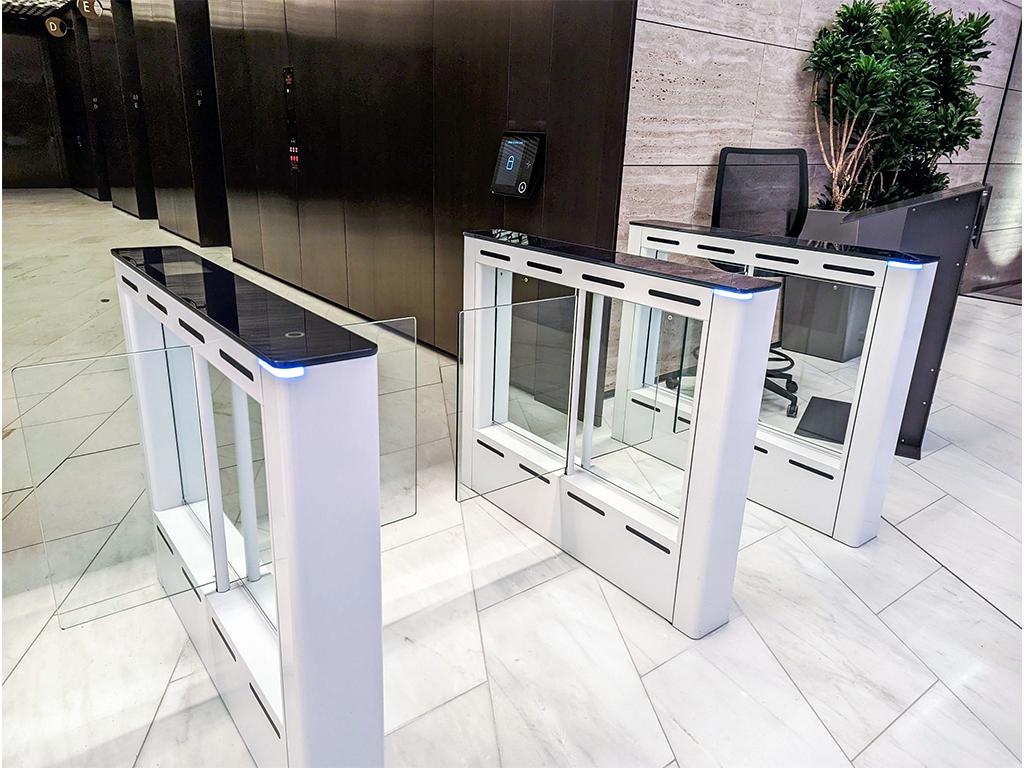
A beautifully designed lobby is a legitimate business priority. But when the look of the entry point drives the product decision instead of the security requirement, you end up with hardware that photographs well and performs poorly. Low-profile speed gates that blend into a minimalist interior may not carry the detection capability a high-security environment demands. Open-lane configurations chosen for their sleek appearance may not provide the physical barrier a threat assessment calls for.
The Fix: Start with the security requirement, then find a product that meets it and fits the space. The good news is that modern entrance control doesn’t force a choice between form and function — optical turnstiles, speed gates, and access gates are available in architecturally refined finishes, custom glass configurations, and compact footprints that work with high-end interior design without compromising performance. Biometric readers and access control hardware have followed the same trajectory — purpose-built enclosures designed for commercial environments that don’t look like they belong in a prison. Define what the space needs to do security-wise first. Then design around it.
7. The Accessible Entry Becomes a Security Gap
Every facility needs an accessible entry point. The problem is how most of them handle it. Rather than incorporating an accessible solution into the primary entry array, many facilities designate a separate door — a side entrance, a service entry, a back door with a reader on it — as the accessible route. That separate entry almost always becomes the weakest point in the building. It’s staffed inconsistently, propped open for convenience, and treated as a secondary concern by everyone except the people who know it’s the easiest way in.
The Fix: Accessible entry should be integrated into the primary entry point — not routed around it. That means incorporating a wider lane or an access gate directly into the main array so every person entering the building moves through the same controlled, monitored, and enforced entry point regardless of mobility needs. A separate accessible entrance is a separate security perimeter — one that rarely gets the same attention as the front door.
The Fastlane® Glassgate 150 Plus offers a 1,000mm (39.4-inch) lane width that accommodates wheelchairs and mobility aids with the same optical detection and credential enforcement as every other lane in the array. In Canada, the City of Toronto 2021 Accessibility Design Guidelines provide specific dimensional requirements for accessible entry points. Accessible doesn’t mean unsecured — and it shouldn’t mean unmonitored.
8. You Bought on Price
The lowest-bid security system rarely wins on lifecycle cost. Whether it’s turnstiles, biometric readers, access control software, cameras, or barrier gates — low-cost products tend to look attractive at the proposal stage and painful a few years later when components fail, parts are unavailable, software support is discontinued, or the platform can’t accommodate a new credential format without a full replacement.
The Fix: Evaluate lifecycle cost across every product in the stack, not just acquisition cost. Key questions to ask before signing any purchase order:
- What is the rated lifespan of the hardware under real operating conditions?
- Are replacement parts stocked domestically and what is the lead time?
- What does the software support roadmap look like — and what happens when it ends?
- Is the system open or proprietary — can it integrate with other platforms as your needs evolve?
- What does downtime cost per hour at each entry point in your facility?
- Can the hardware accommodate future upgrades without a full rip-and-replace?
Fastlane® systems are rated to 10 million cycles. The Fastlane® GG150 LX is a bolt-for-bolt retrofit of the original GG150 — no new floor anchors, no new conduit runs — saving up to approximately $37,000 on a four-lane installation versus a full replacement. That kind of forward compatibility isn’t unique to turnstiles — it’s the standard every product in your security stack should be held to.
9. The Officers Don’t Know What the Alerts Mean
Optical turnstiles generate events. Security officers need to respond to them. When there’s no documented protocol for what a tailgate alert or anti-passback event actually requires, the technology produces noise — and teams stop acting on it. A sophisticated system with an undertrained response is a false sense of security.
The Fix: Pair every entrance control deployment with documented escalation procedures. Define what each alert type requires at the lane level and what triggers escalation. Make clear how to distinguish a system fault from a security event. Pedestrian authentication and authorization at the entry point is where technology and human judgment intersect — both sides need to be ready. ASIS International’s Physical Security Professional (PSP) certification provides a recognized framework for building that competency into your security personnel.
10. The System Won’t Support What’s Coming
The credential landscape is moving faster than most facility refresh cycles. Organizations that locked into proprietary reader formats five years ago are now running costly retrofits to support mobile credentials, biometrics, or multi-factor authentication at the lane. If your entrance control hardware is the bottleneck to adopting new pedestrian authentication and authorization technology, it’s already outdated.
The Fix: Specify reader-agnostic hardware with open-standard interfaces and field-updatable firmware. Ask what credential formats are supported now — and what’s on the roadmap. For a look at how mobile credentials are changing enterprise entry, see our post on mobile credentials and optical turnstiles.
The Real Cost of Getting It Wrong
Every failure on this list has a price tag — and most of them don’t show up until it’s too late. A tailgating event that goes undetected doesn’t generate an incident report. A throughput bottleneck that trains employees to prop doors doesn’t trigger an audit. A system specced on purchase price doesn’t send an invoice when it goes offline at 7:50 AM on a Monday.
The facilities that get this right treat entrance control as a system: the right hardware for the application, built for the throughput your peak headcount demands, integrated with your access control platform, and ready for the credential technology you’ll be deploying in three years. The ones that get it wrong find out the hard way — usually after an incident, an audit, or a replacement budget they didn’t plan for.
If any of these failures sound familiar, that’s where we start. Contact Smarter Security to discuss your entry points with a specialist who knows the product and its application.
This article was reviewed for accuracy by the Director of Marketing, Shana McCoy
Shana McCoy is the Director of Marketing at Smarter Security, the exclusive Americas distributor of Fastlane® optical turnstiles and Door Detective® entrance control solutions. With over a decade of experience in the physical security industry, Shana brings deep expertise in entrance control technology, serving clients across corporate, healthcare, education, and government sectors — including more than half of the Fortune 100. Her work spans product marketing, campaign strategy, and content development, with a focus on helping organizations make informed decisions about access control investments.



